

14 Days
Daily Tour
10 people
___
The Annapurna Base Camp Trek leads into the Annapurna Sanctuary, a high-altitude glacial basin enclosed by peaks above 6,000 m in the Gandaki Province of north-central Nepal. The route covers approximately 70 kilometres from Nayapul (1,070 m) to Annapurna Base Camp (4,130 m), climbing through five ecological zones before reaching the inner sanctuary below Annapurna I (8,091 m), Annapurna South (7,219 m), Hiunchuli (6,441 m), and Machhapuchhre (6,993 m).
The trail passes through the traditional Gurung and Magar villages of Ghandruk and Chhomrong, a pre-dawn sunrise hike to Poon Hill (3,210 m), and a soak in the Jhinu Danda hot springs (1,780 m) on the descent. Two dedicated acclimatisation days at Ghorepani (2,860 m) and Chhomrong (2,170 m) are built into the itinerary, giving trekkers time to adjust before the final ascent above 3,500 m.
This 14-day journey with Kalapatthar keeps trekkers below 4,000 m for all but the base camp night, making the route accessible to a wide range of fitness levels without reducing the quality of the mountain experience. Licensed guides with a minimum of five to seven years of Annapurna region experience manage every permit, teahouse booking, and health check along the way.
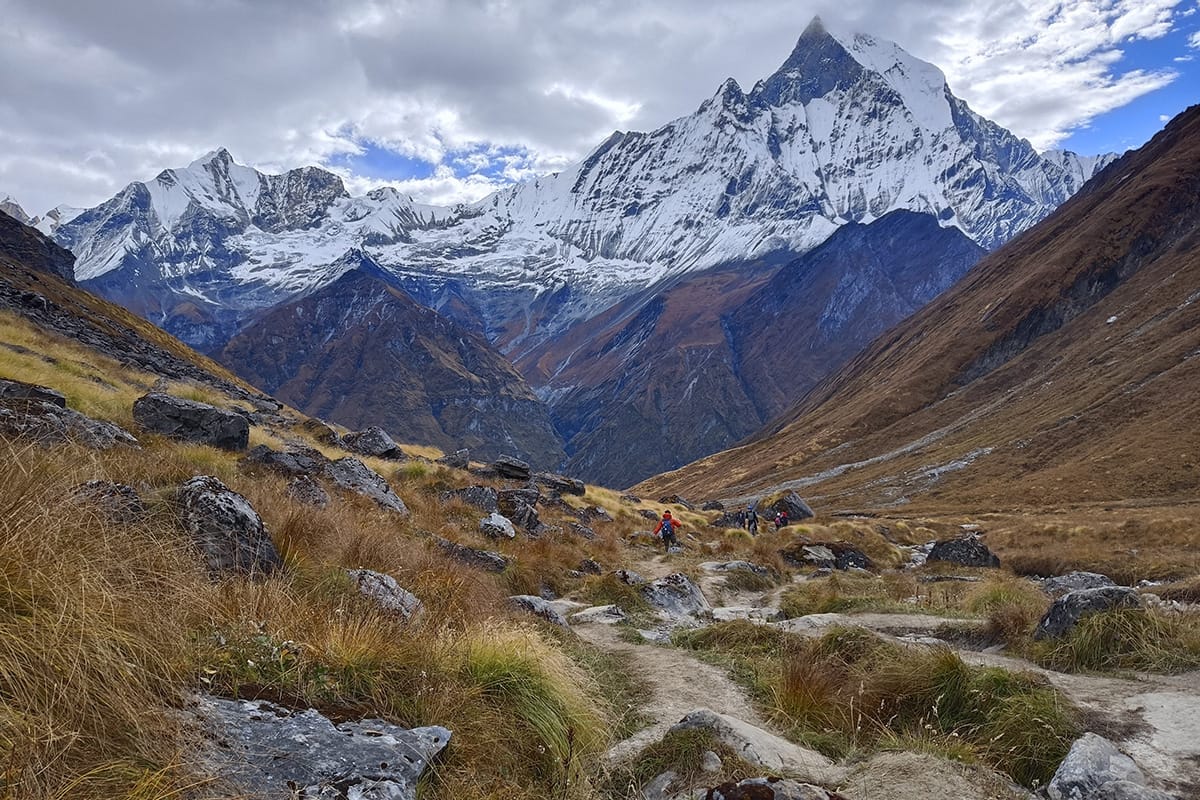
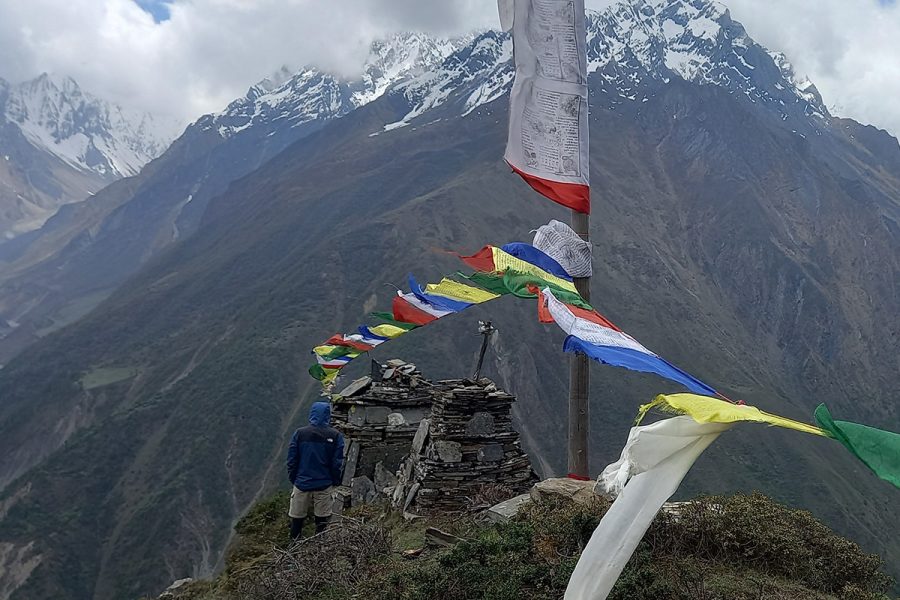
The lower sections wind through subtropical bamboo forest, dense rhododendron woodland, and terraced farmland before the valley narrows above Chhomrong and the terrain shifts into open alpine moraine. Within a single week, the landscape moves from forests where langur monkeys swing through the canopy to the glacial sanctuary itself, with traditional Gurung and Magar villages marking the way.
The Poon Hill sunrise hike delivers panoramic views of Dhaulagiri and the Annapurna range before the trail continues toward Chhomrong, the last major village before the sanctuary corridor. From there, the route climbs steadily past Machhapuchhre Base Camp into the inner basin at Annapurna Base Camp, surrounded on nearly every side by 6,000 m and 7,000 m peaks.
Arrive at Tribhuvan International Airport and transfer to your hotel in Kathmandu with the Kalapatthar team. The evening includes a welcome dinner, team introduction, and a full trek briefing covering permits, safety protocols, and the gear checklist. Your guide takes your first set of vitals, recording your baseline oxygen saturation, pulse rate, and temperature. Overnight at a hotel.
Before breakfast, your guide checks your oxygen levels, pulse, and temperature. Day 2 is reserved for permit processing, gear checks, and any final equipment purchases in Thamel. Kalapatthar handles ACAP and TIMS permit processing at the relevant government offices in Kathmandu. Thamel has well-stocked trekking shops for any missing gear, but inspect quality carefully and avoid purchasing new boots at this stage. Optional guided visits to Boudhanath Stupa, Pashupatinath Temple, or Swayambhunath are available in the afternoon. Early rest is recommended before the drive to Pokhara on Day 3. Evening health check conducted. Overnight at a hotel.
Start your morning with a quick wellness assessment from your guide before breakfast. Depart Kathmandu by tourist bus for a 6 to 7 hour scenic drive along the Prithvi Highway following the Trishuli River. The road winds through terraced hillsides with distant views of Manaslu appearing above the clouds on clear days. A 25-minute domestic flight with views of the Himalayan range is available as an alternative upgrade. Arrive in Pokhara in the afternoon with free time to walk along Phewa Lake. Evening health check conducted. Overnight at a 3-star hotel.
Your guide measures your oxygen saturation and pulse before you head out for the day. A one-hour private jeep drive from Pokhara to Nayapul brings you to the official trek starting point. The trail follows the Modi River through terraced farmlands and small villages to Tikhedhunga, with a gradual net ascent of 470 m over 10 kilometres. Register your ACAP and TIMS permits at the Nayapul checkpoint on arrival. Evening health check conducted. Overnight at a teahouse.
Your guide does a morning health check, recording your vitals before the day's climb. This is the most physically demanding ascent of the entire route, climbing over 1,300 m through dense rhododendron and oak forest on stone staircases. In spring, the forest between Tikhedhunga and Ghorepani produces the most concentrated rhododendron bloom on the entire circuit. Ghorepani sits on a ridge with direct sunset views of Annapurna South at 7,219 m and Dhaulagiri at 8,167 m. Evening health check conducted. Overnight at a teahouse.
Before the pre-dawn hike, your guide quickly checks your oxygen and pulse. Wake at 4:30 AM for the 45-minute pre-dawn hike to Poon Hill at 3,210 m, one of the most recognised sunrise viewpoints in the Annapurna Conservation Area. First light turns Dhaulagiri at 8,167 m, Annapurna South at 7,219 m, Annapurna I at 8,091 m, and Machhapuchhre at 6,993 m into golden peaks above the morning clouds. Return to Ghorepani for breakfast, then trek 6 to 7 hours through pristine forest to Tadapani. Evening health check conducted. Overnight at a teahouse.
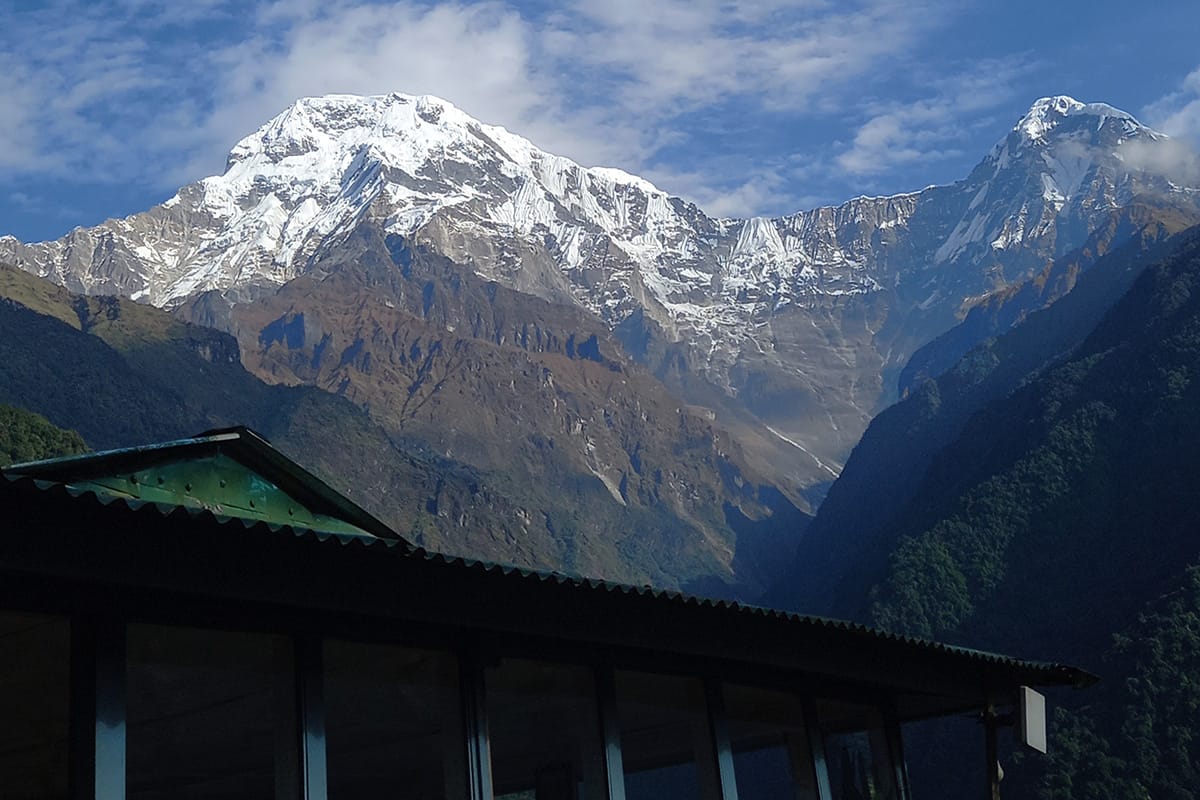
Your guide takes your morning vitals, checking how your body is handling the altitude. The trail descends steeply through bamboo and rhododendron forest to the Kimrong River, followed by an equally steep ascent up stone staircases to Chhomrong. Chhomrong is the last major village before entering the Annapurna Sanctuary corridor, with direct views of Annapurna South and Machhapuchhre from every teahouse. Evening health check conducted. Overnight at a teahouse.
A brief wellness check before breakfast confirms you are ready for another day on the trail. A long stone staircase descends from Chhomrong to a suspension bridge over the Chhomrong River, followed by a gradual ascent through dense bamboo and rhododendron forest. The valley walls narrow significantly above the bridge, with steep cliffs rising on both sides. Evening health check conducted. Overnight at a teahouse.
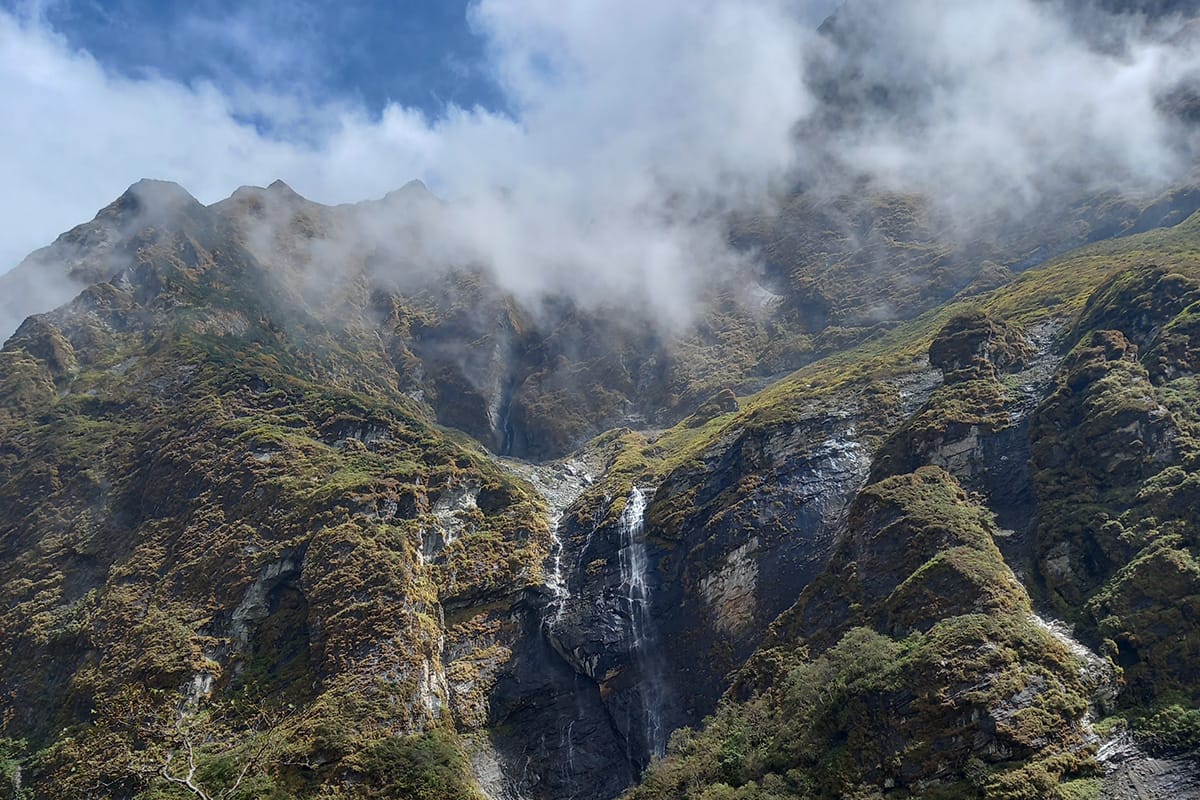
Your guide monitors your oxygen levels and pulse before you start walking. A sustained ascent through forest zones that transition from bamboo to alpine scrub as the valley narrows dramatically. Waterfalls cascade directly onto the trail in several sections above Himalaya Hotel. Himalayan tahr are commonly visible on rocky slopes above Deurali. Hydration of 4 to 5 litres is emphasised throughout the day. An evening health check is conducted. Overnight at a teahouse.
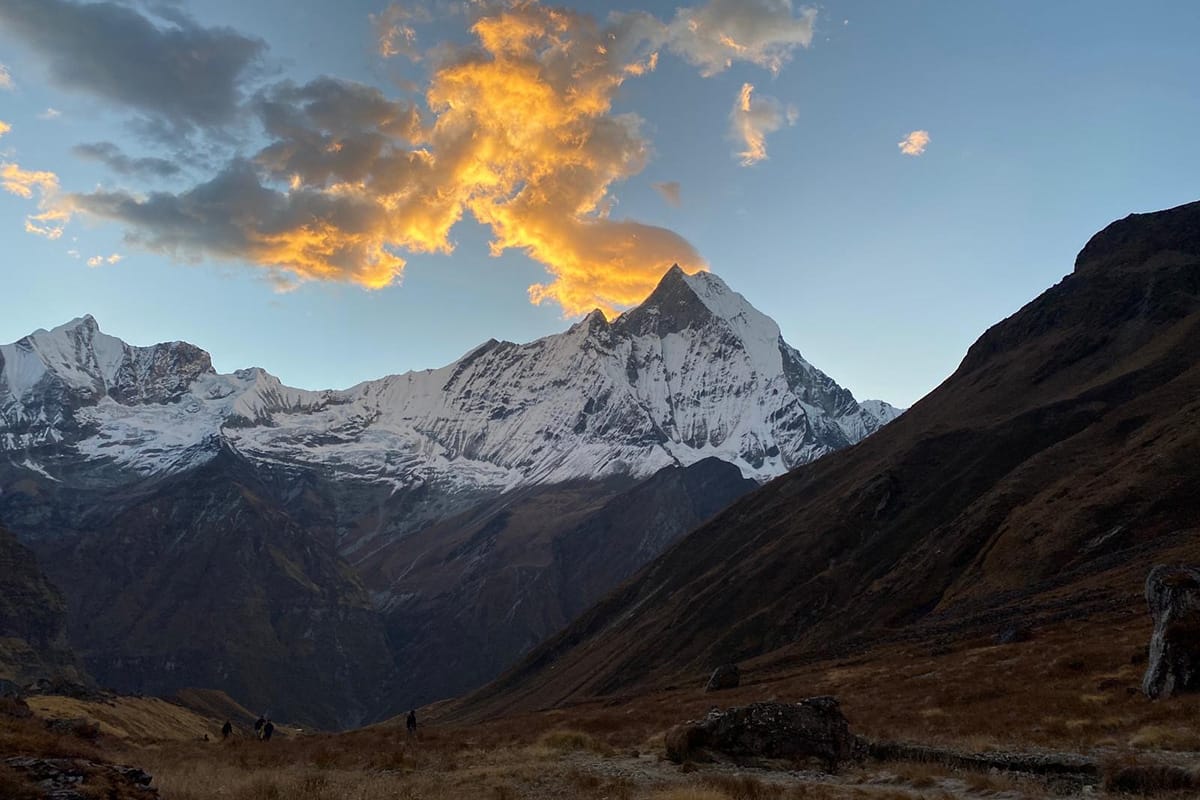
Before breakfast, your guide records your morning vitals at this critical altitude. The final approach day climbs through the Himalayan alpine zone past Machhapuchhre Base Camp at 3,700 m and into the full Annapurna Sanctuary. The circle of peaks closes in as the trail reaches the inner basin at Annapurna Base Camp at 4,130 m, surrounded by Annapurna I at 8,091 m, Annapurna South at 7,219 m, Hiunchuli at 6,441 m, Machhapuchhre at 6,993 m, and Gangapurna at 7,455 m. Watch sunset colours move across the summit snowfields in the evening. Evening health check conducted. Overnight at a teahouse.
Your guide checks your vitals one last time before the long descent begins. Wake early for the sunrise over the Annapurna Massif from base camp, with first light hitting the ice on Annapurna I at approximately 6:15 AM in autumn and 6:45 AM in spring. Begin the descent after breakfast, retracing the sanctuary corridor back through Deurali and Himalaya Hotel to Bamboo. The 1,820 m descent is the most knee-intensive section of the full route; trekking poles are essential. Evening health check conducted. Overnight at a teahouse.
A quick morning wellness check confirms you are recovering well from the long descent. The trail descends through bamboo and rhododendron forest back through Chhomrong and continues down to Jhinu Danda. The Jhinu Danda hot springs sit a short 15-minute walk below the village at the riverbank, with pools maintained at 38 to 40 degrees Celsius year-round. A soak of 30 to 45 minutes eases tired muscles after 10 days of trekking. Evening health check conducted. Overnight at a teahouse.
Your guide takes your final morning vitals on the trail before the last short walk. A short final trekking section descends from Jhinu Danda through Syauli Bazaar and Birethanti to the trailhead at Nayapul. A private jeep covers the 1 to 2-hour return drive from Nayapul to Pokhara, arriving in the early afternoon with time for rest, a hot shower, and a relaxed lakeside dinner. Evening health check conducted. Overnight at a 3-star hotel.
One last wellness check before you leave Pokhara ensures you are healthy for your journey home. Return to Kathmandu by tourist bus along the Prithvi Highway for 6 to 7 hours or by the 25-minute morning domestic flight with mountain views on clear days. Arrive in Kathmandu with the afternoon free for rest, souvenir shopping in Thamel, or arranging onward travel. Your Kalapatthar completion certificate is issued, and the trek officially concludes with a hotel night included for your final evening. Overnight at a hotel.
This Annapurna Base Camp Trek package runs for 14 days, including arrival, preparation, travel, trekking days, and departure. The trekking section itself covers approximately 70 kilometres over 10 days, including the sunrise hike to Poon Hill and the visit to Annapurna Base Camp at 4,130 metres.
The trek is rated Moderate and is suitable for trekkers with a reasonable level of fitness. Daily walking times average 5 to 7 hours on well-maintained mountain trails, stone staircases, and forest paths. No technical climbing skills are required.
Previous trekking experience is helpful but not mandatory. Many first-time trekkers successfully complete the Annapurna Base Camp Trek each year. Regular cardio training and good physical preparation before arrival will greatly improve your experience.
The highest point of the trek is Annapurna Base Camp at 4,130 metres (13,550 feet). While this is lower than Everest Base Camp and the Annapurna Circuit's Thorong La Pass, altitude sickness can still occur, making proper acclimatisation important.
The best seasons are spring from March to May, offering rhododendron blooms, pleasant temperatures, and excellent mountain views, and autumn from September to November, offering clear skies, stable weather, and the best overall trekking conditions. October is widely considered the single best month for the trek.
Yes. Although the trek is not considered extremely high altitude, Annapurna Base Camp sits above 4,000 metres where Acute Mountain Sickness (AMS) can occur. Kalapatthar guides conduct daily health monitoring and follow strict safety procedures if any symptoms develop. Hydration of 4 to 5 litres of water per day is strongly recommended.
Two permits are required: Annapurna Conservation Area Permit (ACAP) at NPR 3,000 per person and Trekkers Information Management System (TIMS) Card at NPR 1,000 per person. Kalapatthar handles all permit processing before the trek begins.
Accommodation is provided in locally owned teahouses throughout the route. Rooms are generally twin-sharing, with shared bathroom facilities at most locations. In Kathmandu and Pokhara, accommodation is provided in comfortable 3-star hotels with attached bathrooms and breakfast included.
Breakfast, lunch, and dinner are included throughout the trekking portion of the itinerary, along with unlimited tea and coffee. Common menu options include dal bhat, fried rice, noodle soup, pasta, Tibetan bread, pancakes, oatmeal, and egg-based meals. Special dietary requirements can be accommodated with advance notice.
Yes. Safe drinking water is available throughout the route. Trekkers can refill bottles at teahouses and use purification tablets or water filters. Staying hydrated with 4 to 5 litres per day is important, especially above 2,500 metres.
Yes. Comprehensive travel insurance is mandatory for all participants. Your policy must cover high-altitude trekking, emergency helicopter evacuation, medical treatment and hospitalisation, and trip interruption and cancellation. Proof of insurance is required before the trek begins.
Yes. The package includes a government-licensed trekking guide and porter support. One porter is shared between two trekkers and carries up to 15 kilograms of luggage.
Wi-Fi is available at many teahouses along the route for a small additional fee paid directly to the teahouse. Mobile network coverage is generally reliable up to Chhomrong, while coverage becomes limited closer to Annapurna Base Camp.
The Annapurna Conservation Area is home to a variety of wildlife, including Himalayan tahr (commonly seen on rocky slopes near Chhomrong and Bamboo), langur monkeys (frequently observed between Tikhedhunga and Ghorepani), Himalayan Monal or Danphe (Nepal's national bird, regularly spotted between Ghorepani and Chhomrong), Himalayan griffon vultures, and alpine choughs. Wildlife sightings are most common during the early morning hours.
Inform your guide immediately. Kalapatthar guides conduct daily health checks and are trained to identify symptoms of altitude-related illnesses. If necessary, descent, medical treatment, or helicopter evacuation procedures will be initiated without delay.
Yes. The Annapurna Base Camp Trek is often recommended as one of the best first Himalayan trekking experiences. With proper preparation, a positive attitude, and guidance from experienced staff, most healthy individuals can successfully complete the trek.
The Annapurna Base Camp Trek takes trekkers directly into the Annapurna Sanctuary and reaches a maximum altitude of 4,130 metres. The trek is shorter, takes approximately 7 to 14 days depending on the itinerary, and is considered moderate in difficulty. The Annapurna Circuit Trek circles the entire Annapurna Massif, crosses Thorong La Pass at 5,416 metres, covers greater distances, takes approximately 14 to 21 days, and is considered more physically demanding.
Booking at least one to three months in advance is recommended, particularly for the busy spring and autumn seasons. Early booking helps secure the best accommodation, guide availability, and transportation arrangements.
Personal trail expenses including hot showers, battery charging, Wi-Fi access, and laundry services at teahouses along the route.
You can contact Kalapatthar Trek & Expedition Pvt. Ltd. directly to discuss your preferred travel dates, group size, and trekking requirements. Our team will provide a personalised itinerary, detailed quotation, and complete pre-departure support to help you prepare for your Himalayan adventure.

Member Since 2026

Leave a review