
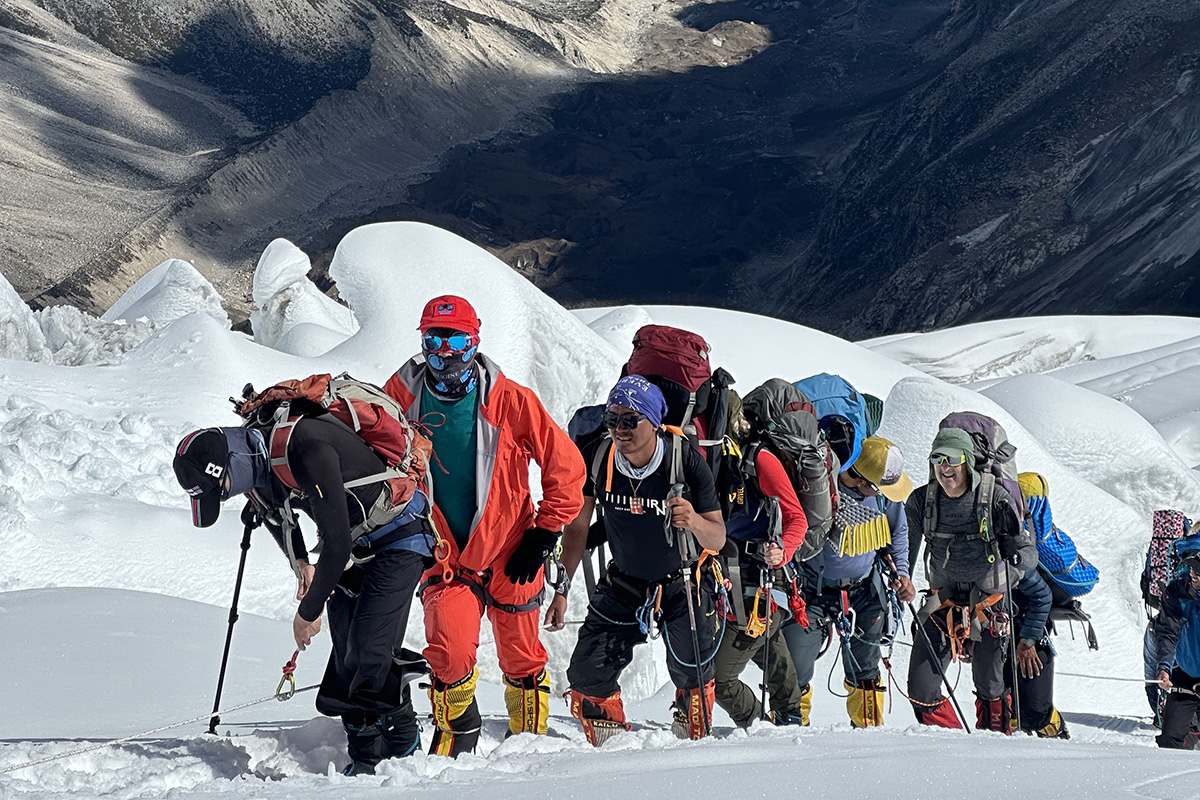

Proper gear selection can determine the success or failure of a high-altitude expedition. At extreme altitudes, equipment failures are not inconveniences; they are life-threatening emergencies. This guide covers every piece of gear you need for a Himalayan expedition, from base layer to summit suit, with recommendations on brands, quantities, and whether to buy or hire.
This guide is designed for trekkers and climbers planning expeditions in Nepal, from classic teahouse treks to high-altitude mountaineering above 7,000 meters. It covers essential clothing, technical equipment, camping gear, and safety items, with practical advice on what to buy, what to hire, and what your expedition operator will provide. For peaks requiring a climbing permit, the Nepal Mountaineering Association oversees regulations and safety guidelines for many of the country’s trekking peaks.
The Layering System: Foundation of Mountain Protection
The three-layer system is the cornerstone of mountain clothing. It consists of a base layer that wicks moisture, a mid-layer that insulates, and an outer layer that protects against wind and precipitation. By adjusting layers according to weather and activity level, climbers maintain a comfortable microclimate and maximize garment performance.
A. Headwear
1. Woolen Cap (Beanie)
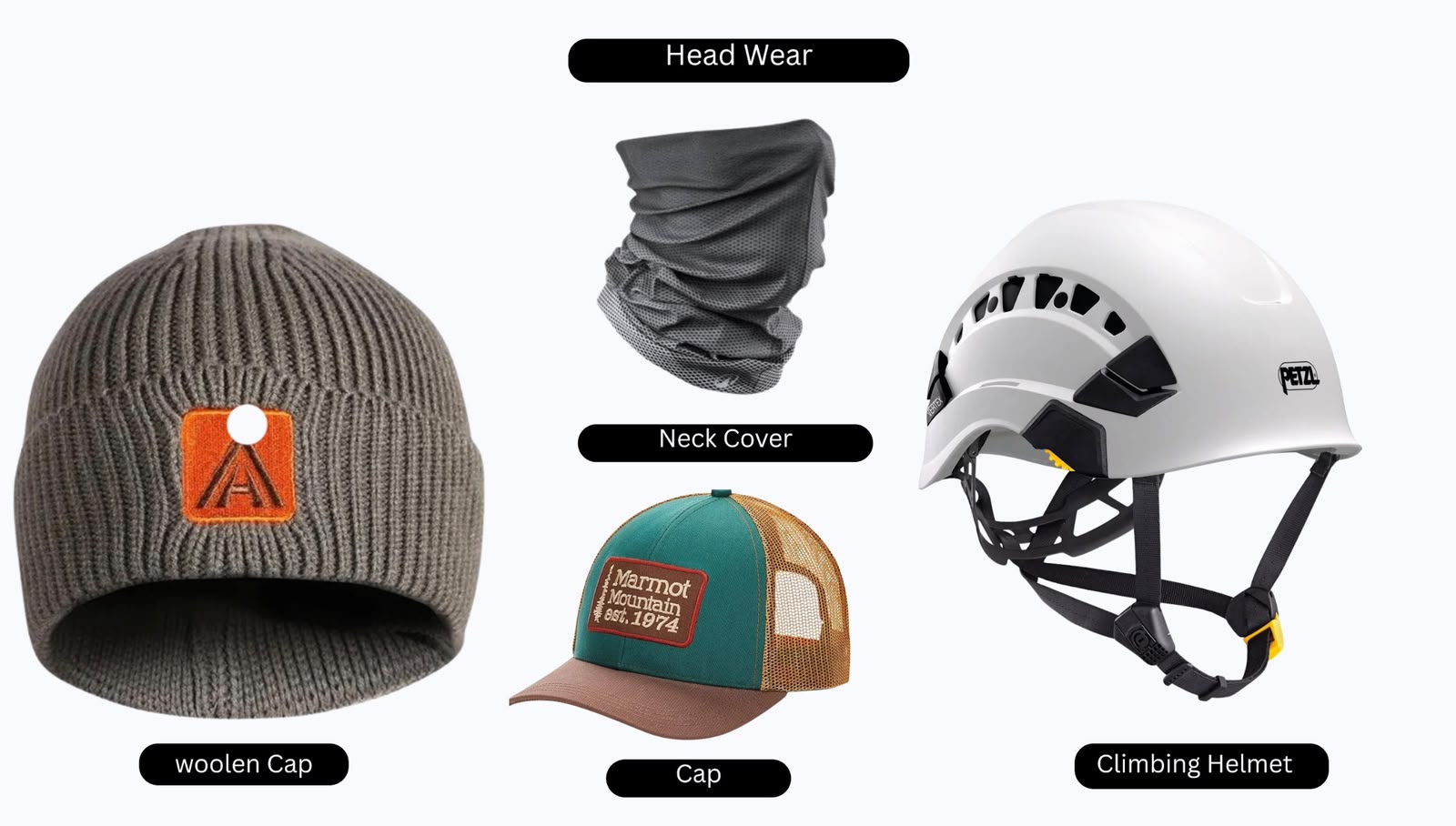
A woolen cap provides essential cold-weather insulation, as significant body heat escapes through an unprotected head. The beanie traps warm air close to the scalp while shielding the ears from freezing temperatures and biting winds.
Popular Brands: Carhartt, The North Face, Arc’teryx, Patagonia
Recommended Quantity: 1 to 2
Buy or Hire: Hire in Kathmandu
2. Neck Cover (Gaiter or Buff)
A neck cover offers versatile protection against harsh sun, wind, dust, and cold. It bridges the gap between jacket and headwear, preventing cold drafts from chilling the neck or chest. It can be pulled up over the mouth and nose to serve as a dust mask or sun shield at high altitudes.
Popular Brands: Buff, Black Diamond, Smartwool
Recommended Quantity: 1
Buy or Hire: Buy in Kathmandu
3. Cap (Trucker or Baseball Cap)
A cap provides sun protection and ventilation during warmer outdoor activities. The front brim shades the eyes and face from direct sunlight, reducing glare and preventing sunburn.
Popular Brands: Marmot, Patagonia, Columbia, New Era
Recommended Quantity: 1
Buy or Hire: Buy in Kathmandu
4. Climbing Helmet
A climbing helmet is critical life-saving equipment designed to protect the skull from traumatic injuries. The helmet absorbs the impact of falling rocks, ice, or dropped gear from climbers above and protects the head during a fall. Look for a helmet certified to UIAA safety standards, which test equipment against impact and penetration scenarios specific to mountaineering.
Popular Brands: Petzl, Black Diamond, Mammut, Camp
Recommended Quantity: 1
Buy or Hire: Hire in Kathmandu
B. Down Suits
Above 7,000 meters, and especially within the 8,000-meter Death Zone, the human body struggles to generate its own heat due to severe hypoxia. At these extreme altitudes, temperatures frequently drop below -40 degrees Celsius alongside violent freezing winds.
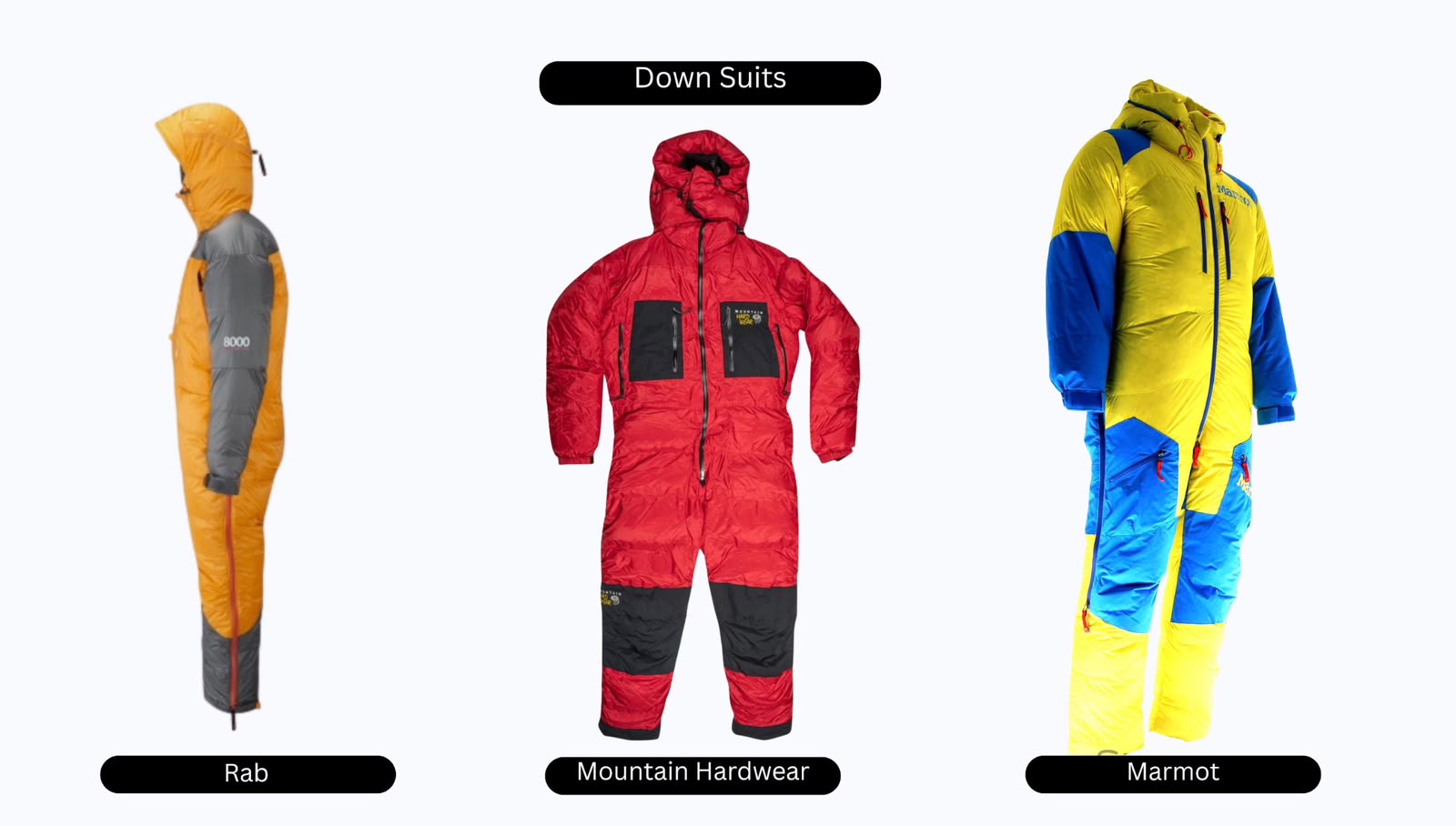
A full down suit is vital because its one-piece design eliminates the waist gap found in traditional jacket-and-pants setups, preventing icy drafts from seeping in and offering life-saving protection against severe hypothermia and frostbite.
Popular Brands: Rab, Mountain Hardwear, Marmot, The North Face, Millet
Recommended Quantity: 1
Buy or Hire: Usually provided by expedition operators; confirm with your operator
C. Upper Body Wear
1. Base Layer
The base layer is the foundation of the outdoor layering system, worn directly against the skin to regulate moisture and temperature. Its primary function is moisture management, wicking sweat away from the body to keep you dry and prevent rapid chilling that occurs when wet fabric sits against the skin in cold or windy environments. Choose moisture-wicking materials like merino wool or synthetic fibers.
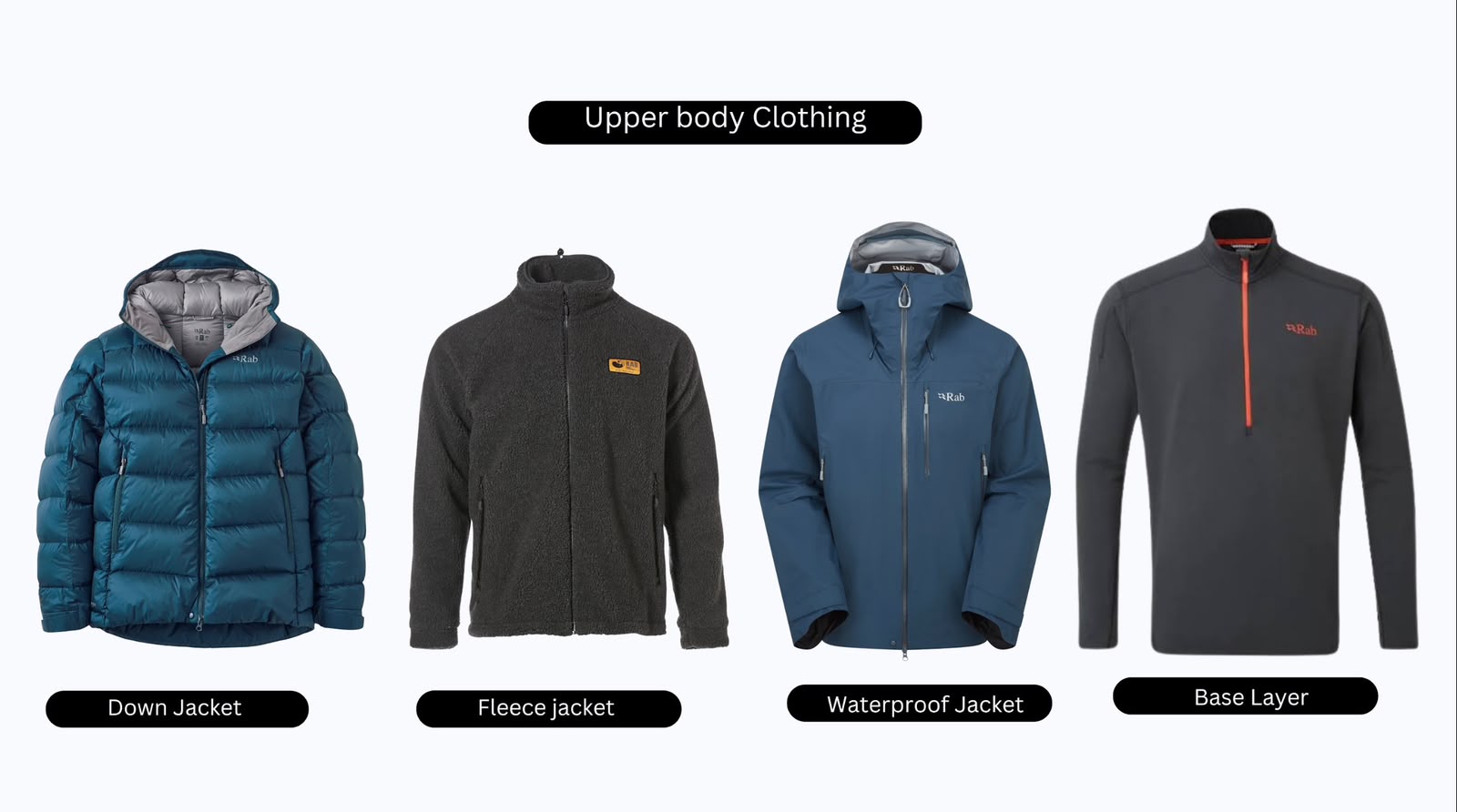
Popular Brands: Rab, Smartwool, Icebreaker, Patagonia
Recommended Quantity: 2 to 3
Buy or Hire: Buy in Kathmandu
Also Read: Trekking in Nepal: The Complete 2026 Guide to Routes, Permits, and Planning
2. Fleece Jacket
The fleece jacket serves as the mid-layer, providing lightweight, breathable insulation that traps warmth during active outdoor pursuits. The fleece traps pockets of warm air generated by the body within its brushed fibers while remaining highly breathable, allowing sweat vapor to escape while keeping you warm during high-exertion activities.
Popular Brands: Rab, Patagonia, Columbia, The North Face
Recommended Quantity: 1 to 2
Buy or Hire: Buy in Kathmandu
3. Waterproof Jacket (Hard Shell)
The waterproof jacket is the outer protective shell layer, engineered to defend against severe weather conditions. It provides an impermeable barrier against heavy rain, snow, and howling winds.
High-quality waterproof jackets use specialized breathable membranes like Gore-Tex that keep external water out while allowing internal sweat vapor to vent. The jacket should have a hood that fits over your climbing helmet.
Popular Brands: Rab, Arc’teryx, Mountain Hardwear, Patagonia
Recommended Quantity: 1
Buy or Hire: Buy in Kathmandu (higher quality recommended)
4. Down Jacket
The down jacket serves as the heavy insulation layer, typically packed with lofted duck or goose down feathers for maximum warmth. It traps an exceptionally high amount of body heat relative to its weight.
Because it compresses incredibly small, it is easy to pack and is vital for staying warm during rest stops, at cold high-altitude camps, or during sub-zero summit pushes. Jackets with higher fill power, such as 700 to 800 plus, provide more warmth for less weight.
Popular Brands: Rab, Mountain Hardwear, Feathered Friends, The North Face
Recommended Quantity: 1
Buy or Hire: Usually provided by expedition operators; confirm with your operator
D. Lower Body Wear
1. Base Layer / Thermal Inner Pants
These close-fitting leggings serve as the foundation of lower-body warmth. Their primary function is to wick sweat away from the skin while providing a baseline layer of insulation. By keeping the legs dry during strenuous movement, they prevent rapid cooling that occurs when moisture is trapped against the skin in cold climates.
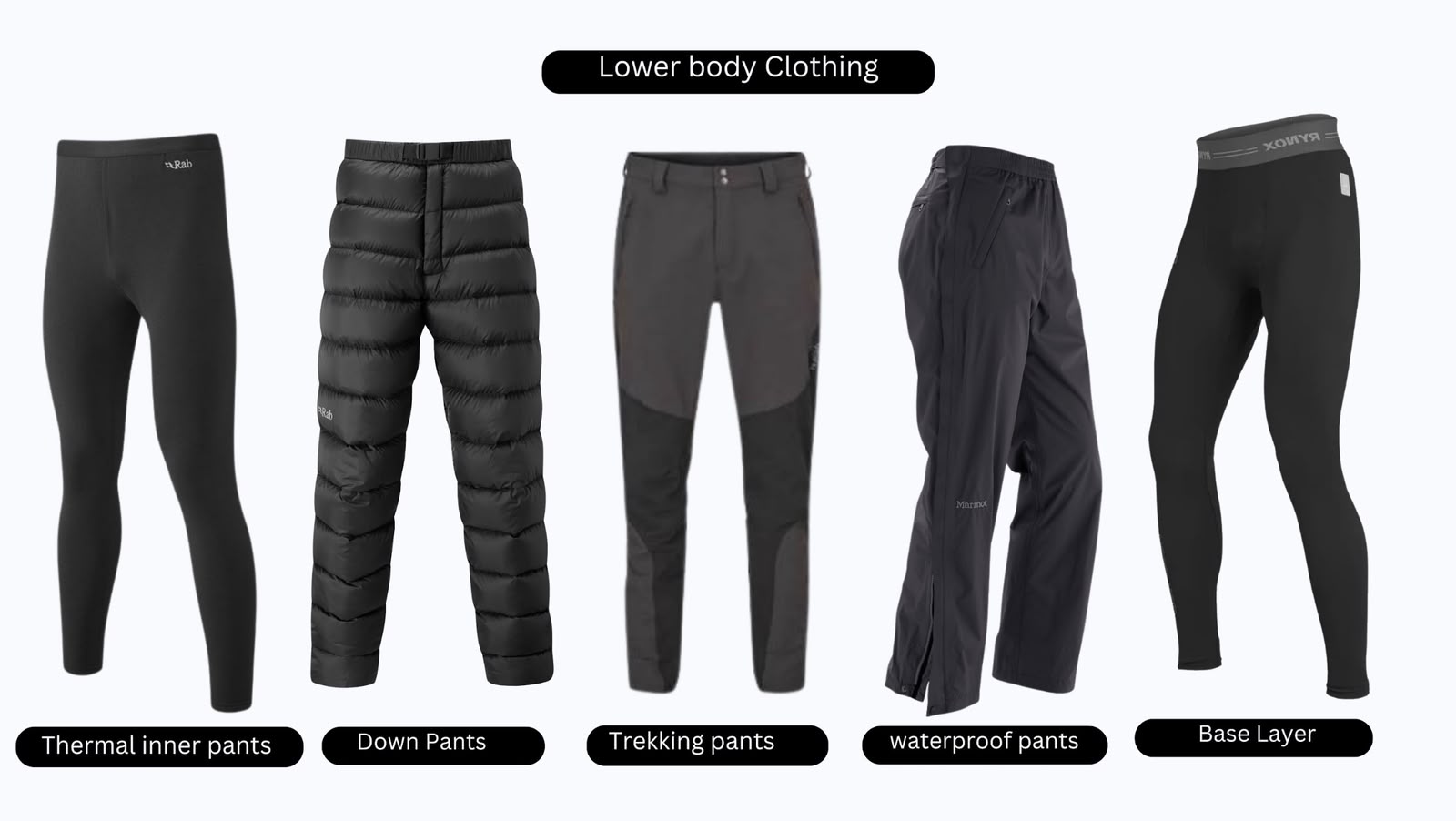
Popular Brands: Rab, Smartwool, Icebreaker, Under Armour
Recommended Quantity: 2
Buy or Hire: Buy in Kathmandu
2. Trekking Pants
Trekking pants are the primary durable outer garment for day-to-day hiking and climbing in moderate outdoor conditions. They offer high mobility, breathability, and protection from abrasions, rough rocks, and trail debris. They are typically made of stretchy, quick-drying synthetic fabrics, often featuring reinforced panels on the knees and seat.
Popular Brands: Fjallraven, Prana, Arc’teryx, Columbia
Recommended Quantity: 2
Buy or Hire: Buy in Kathmandu
3. Waterproof Pants (Hard Shell)
Waterproof pants are specialized weather-resistant outer pants designed to protect the lower body from harsh, wet, or snowy conditions. They completely block external water, sleet, and freezing winds from soaking through inner layers.
They utilize breathable waterproof membranes and feature side zippers for easy ventilation and quick removal over hiking boots. Full-length side zips are highly recommended so they can be put on without removing other layers or boots.
Popular Brands: Marmot, Arc’teryx, Patagonia, The North Face
Recommended Quantity: 1
Buy or Hire: Buy in Kathmandu
4. Down Pants
Down pants represent the ultimate insulation layer for the lower body, packed with high-loft down feathers to combat sub-zero temperatures. They trap an immense amount of body heat around the legs and core while remaining lightweight and packable. They are vital for maintaining warmth when sitting around a freezing high-altitude camp or dealing with extreme alpine cold.
Popular Brands: Rab, Mountain Hardwear, Feathered Friends, Western Mountaineering
Recommended Quantity: 1
Buy or Hire: Usually provided by expedition operators; confirm with your operator
E. Footwear
1. Camping Sandals or Hut Slippers
These lightweight footwear options are designed exclusively for recovery and relaxation around base camp or alpine tea houses. They allow the feet to breathe, dry out, and recover after a day inside stiff, heavy mountaineering boots. Down-filled hut slippers trap critical body heat around the feet to prevent frostbite when resting in freezing high-altitude tents.
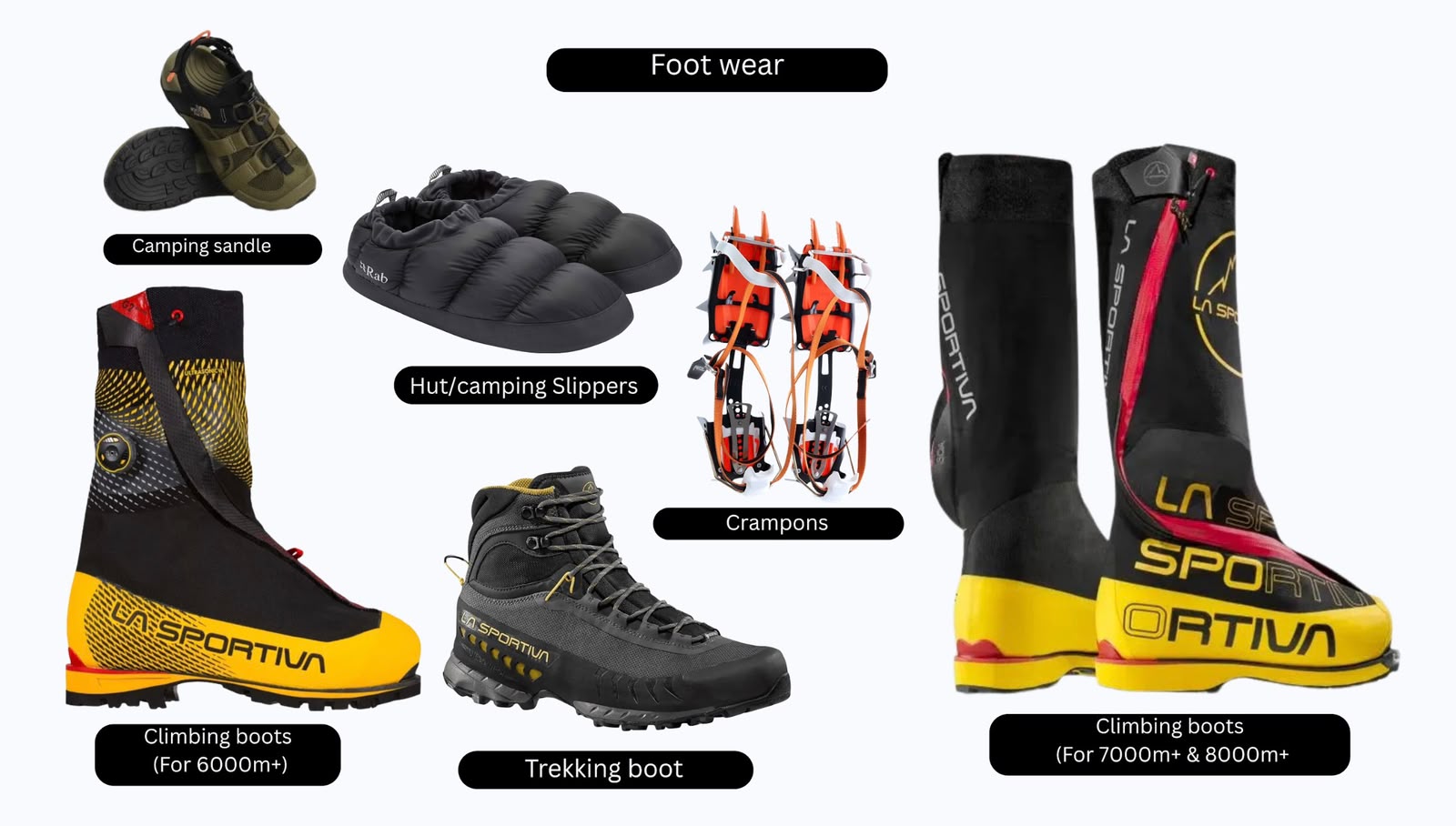
Popular Brands: Rab, The North Face, Teva, Crocs
Recommended Quantity: 1 pair
Buy or Hire: Buy in Kathmandu
2. Trekking Boots
Trekking boots are rugged, ankle-height boots engineered as the main footwear for long approach hikes, rugged terrain, and lower-altitude alpine trails. They provide robust ankle support, prevent slips, and absorb impact when carrying heavy backpacks over uneven terrain. They feature deeply grooved rubber outsoles like Vibram for traction on mud, loose gravel, and rock. Fit is more important than brand; take time to select a pair that fits your foot and break them in well.
Popular Brands: La Sportiva, Lowa, Salomon, Scarpa
Recommended Quantity: 1 pair
Buy or Hire: Buy in Kathmandu (must be broken in before expedition)
3. Climbing Boots (6000m+)
These heavily insulated, semi-rigid or rigid double boots are engineered for extreme cold, technical ice, and glacier climbing up to 6,000-meter peaks. They shield the feet from severe frostbite while providing the rock-solid stiffness needed for technical ice climbing.
Climbing Boots feature a removable insulated inner liner for warmth and quick drying, combined with a tough, water-resistant outer shell with dedicated heel and toe ridges for crampon attachment.
Popular Brands: La Sportiva, Scarpa, Millet
Recommended Quantity: 1 pair
Buy or Hire: Hire in Kathmandu
4. Crampons
Crampons are specialized metal frames with spikes designed to be securely fastened to the bottom of technical mountaineering boots. They provide life-saving mechanical traction on hard glacial ice, steep snow slopes, and frozen rock faces.
The sharp bottom spikes bite vertically into horizontal ice surfaces, while the aggressive front
points allow climbers to kick directly into near-vertical ice walls. Ensure compatibility with your boots.
Popular Brands: Grivel, Black Diamond, Petzl, Camp
Recommended Quantity: 1 pair
Buy or Hire: Hire in Kathmandu
5. Climbing Boots (7000m+ and 8000m+)
These massive, triple-layered, ultra-insulated boots are specialized life-support gear designed for the Death Zone and extreme high-altitude expeditions. They prevent catastrophic frostbite and toe amputations in temperatures that plummet below -40 degrees Celsius.
They combine a heavily insulated inner boot, a rigid mid-shell, and an integrated, knee-high weatherproof gaiter that seals out deep snow and traps core heat.
Popular Brands: La Sportiva, Scarpa, Millet
Recommended Quantity: 1 pair
Buy or Hire: Hire in Kathmandu or provided by expedition operators
F. Handwear
1. Liner / Lightweight Climbing Gloves
These lightweight, form-fitting gloves serve as the essential base layer for the hands. They provide a baseline layer of thermal protection while maintaining maximum finger dexterity. They wick moisture away from the skin and protect bare hands from instantly freezing to metal gear like carabiners, ice axes, or jumar ascenders.
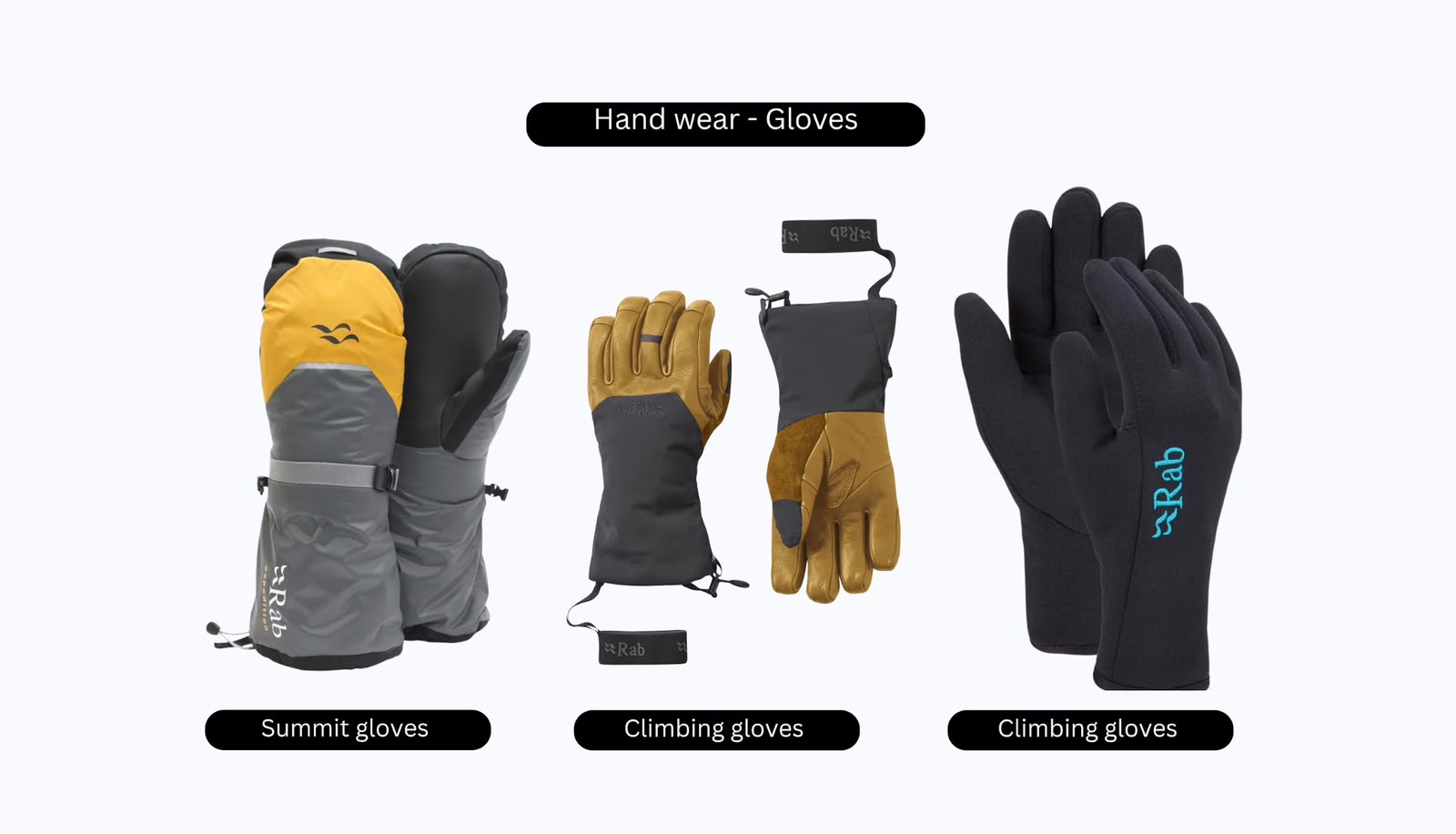
Popular Brands: Rab, Outdoor Research, Black Diamond, Arc’teryx
Recommended Quantity: 2 pairs
Buy or Hire: Buy in Kathmandu
You May Also Prefer Reading: Things to Consider Before Coming for the Expedition in Nepal
2. Mid-Weight Climbing Gloves
These durable, insulated, weather-resistant gloves are built for active climbing in cold environments. They balance dependable warmth with high physical durability and grip during technical mountaineering. They typically feature tough leather palms to withstand the friction of handling ropes and ice axes, combined with a waterproof or windproof membrane.
Popular Brands: Rab, Black Diamond, Hestra, Mountain Handwear
Recommended Quantity: 1 pair
Buy or Hire: Buy in Kathmandu
3. Summit Gloves (Mittens)
These heavily insulated, high-loft down or synthetic mittens are engineered for extreme sub-zero conditions and high-altitude peaks. Their priority is maximum heat retention to prevent catastrophic frostbite in the severe cold of 7,000-meter and 8,000-meter environments.
By keeping fingers grouped together inside a single insulated pocket, they drastically minimize heat loss, while extra-long gauntlet cuffs seal out freezing wind and deep snow.
Popular Brands: Rab, Black Diamond, The North Face, Outdoor Research
Recommended Quantity: 1 pair
Buy or Hire: Hire in Kathmandu
G. Camping Equipment
1. Sleeping Bag (-40 degrees Celsius)
This highly insulated, mummy-shaped down sleeping bag is designed for sub-zero alpine survival. Its primary function is to retain core body heat and keep the climber alive during extreme cold-weather expeditions where overnight temperatures plummet drastically.
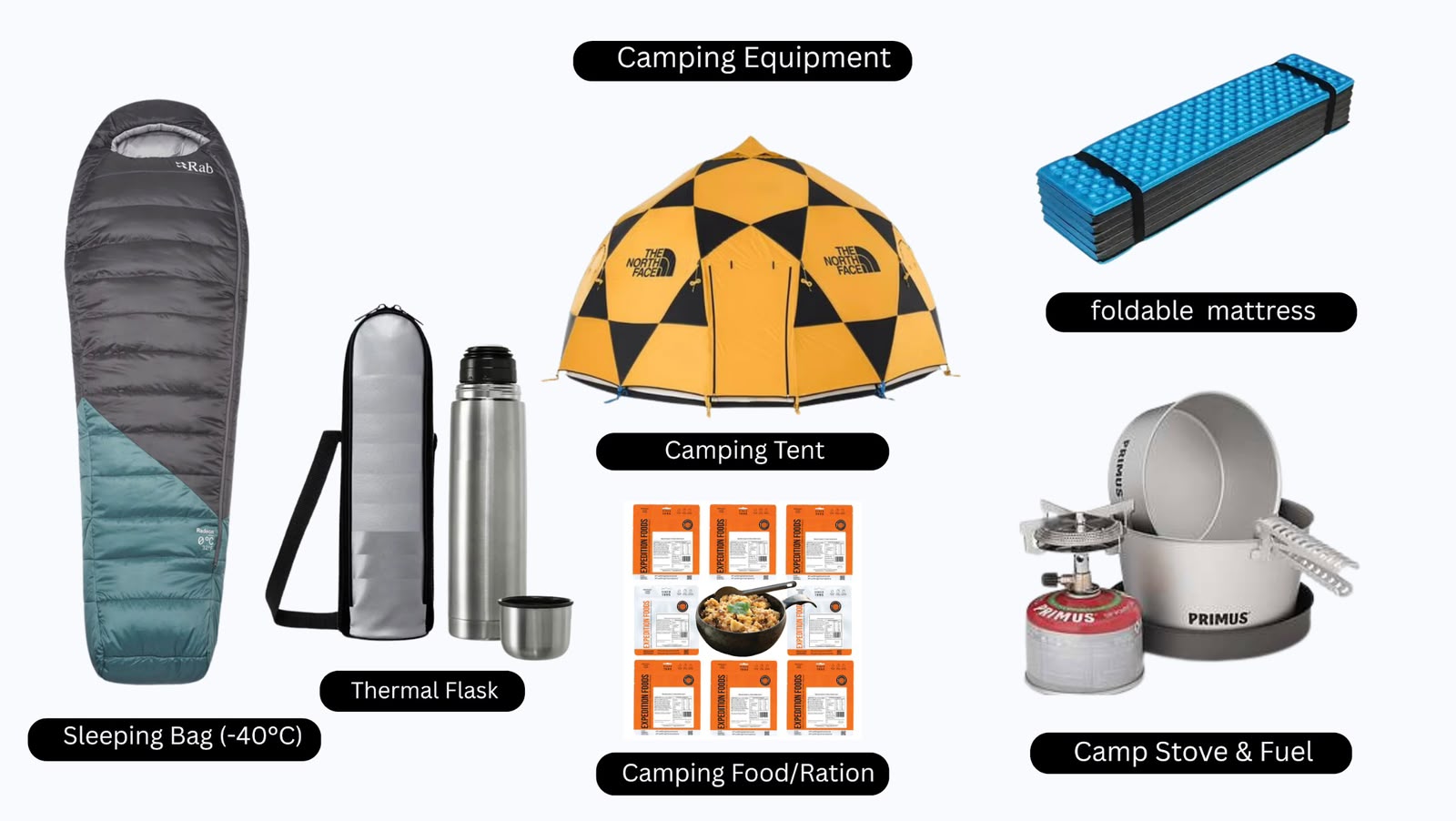
The tapered contour eliminates empty pockets of space, while specialized down baffles and an insulated hood lock warmth inside. Expedition-quality bags rated to -20 degrees Fahrenheit are the minimum acceptable for high-altitude expeditions.
Popular Brands: Rab, Mountain Hardwear, Western Mountaineering, Feathered Friends
Recommended Quantity: 1
Buy or Hire: Usually provided by expedition operators; confirm with your operator
2. Thermal Flask
This double-walled, vacuum-insulated stainless-steel bottle with a protective carrying sleeve and screw cap maintains the temperature of liquids, preventing drinking water or tea from freezing into solid ice at high altitudes. The vacuum layer between its steel walls stops heat transfer, ensuring climbers have instant access to hot hydration or melted snow.
Popular Brands: Thermos, Hydro Flask, Stanley, Zojirushi
Recommended Quantity: 1 to 2
Buy or Hire: Buy in Kathmandu
3. Camping Tent
This heavy-duty, geodesic dome tent is engineered specifically for high-altitude base camps and extreme weather. It provides structural shelter against snowstorms, heavy snow accumulation, and fierce mountain winds. The specialized multi-pole crossing design distributes stress evenly across the structure, while the durable waterproof rainfly seals out freezing precipitation.
Popular Brands: The North Face, Mountain Hardwear, MSR
Recommended Quantity: 1 (shared between climbers)
Buy or Hire: Provided by expedition operators
4. Foldable Mattress (Sleeping Pad)
This lightweight, closed-cell foam sleeping pad folds into a compact accordion shape. It provides vital thermal insulation by creating a physical barrier between the sleeping bag and the frozen ground or ice beneath the tent. The dimpled surface pattern traps warm air pockets while offering physical cushioning against rocky terrain. Most climbers bring two sleeping pads, one closed-cell foam and one inflatable insulated pad.
Popular Brands: Therm-a-Rest, Nemo Equipment, Exped
Recommended Quantity: 1
Buy or Hire: Usually provided by expedition operators
5. Camping Food / Ration
These lightweight, freeze-dried meal pouches are formulated for backcountry and high-altitude nourishment. They supply high-calorie, nutrient-dense fuel to climbers whose bodies are burning massive amounts of energy in high-stress environments.
The moisture is entirely removed during processing, making them lightweight to pack and requiring minimal fuel to prepare. Plan for 4,000 to 5,000 calories per person per day at high altitudes.
Popular Brands: Expedition Foods, Mountain House, Backpacker’s Pantry
Recommended Quantity: As per expedition duration
Buy or Hire: Provided by expedition operators
6. Camp Stove and Fuel
This system consists of a compact canister burner, specialized outdoor cookware, and a pressurized gas canister. It provides a reliable, high-output heat source for cooking meals and, most importantly, melting snow and ice into drinkable water.
At extreme altitudes, dehydration is a constant threat, making a high-efficiency stove system indispensable. White gas stoves have been a staple on high-altitude expeditions for decades and provide reliable performance in cold weather.
Popular Brands: Primus, MSR, Jetboil
Recommended Quantity: 1 (shared between climbers)
Buy or Hire: Provided by expedition operators
H. Goggles and Sunglasses
1. UV Protection Sunglasses (Glacier Glasses)
These specialized high-altitude sunglasses feature classic round leather-shield styles and wrapped sport frames designed for intense alpine environments. They completely block harmful ultraviolet rays, specifically Category 4 UV radiation, and eliminate snow blindness, a painful condition caused by high-altitude snow reflecting up to 80 percent of sunlight.
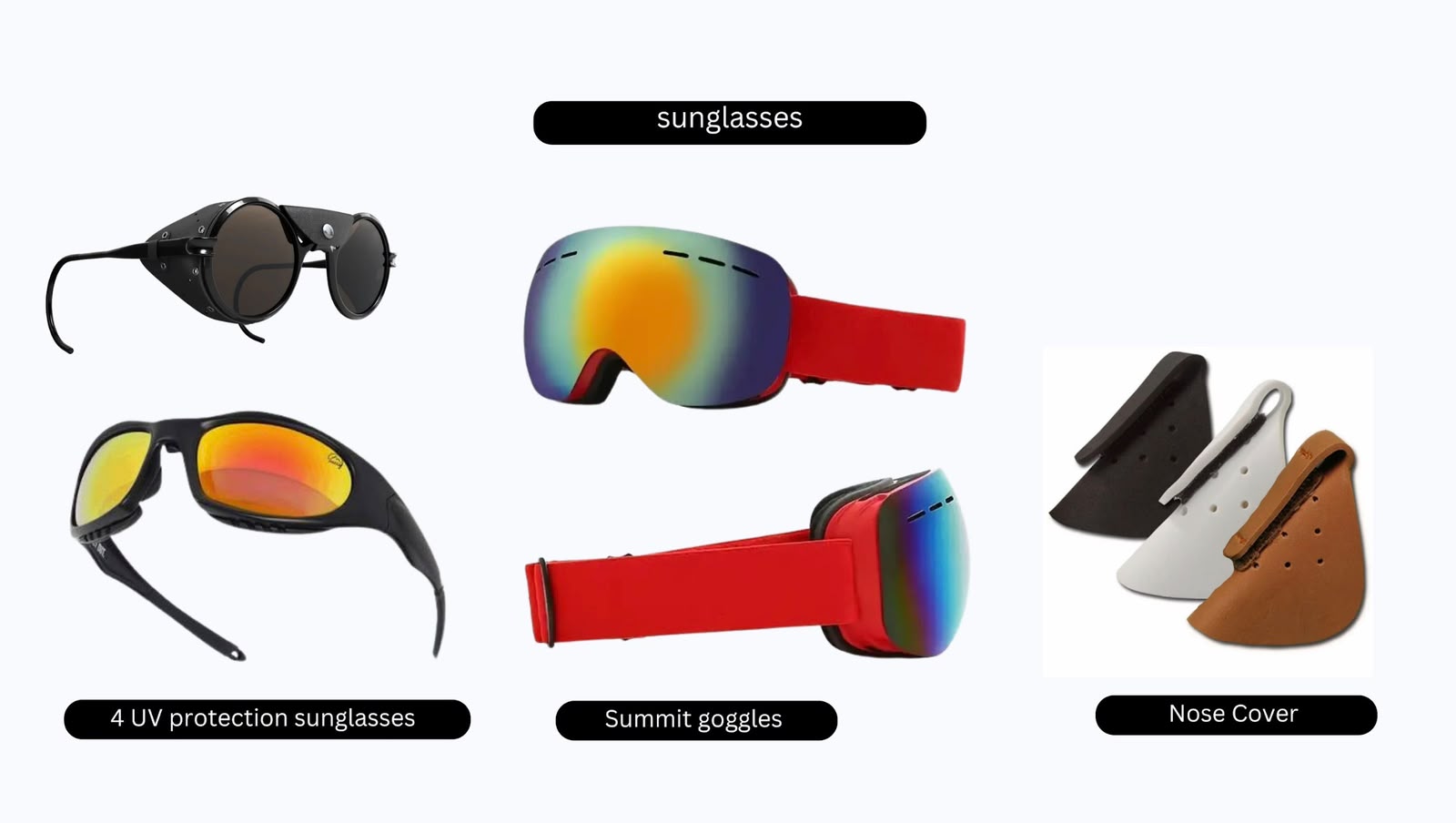
They feature ultra-dark lenses and integrated side shields that prevent peripheral sunlight, wind, and harsh glare from bouncing into the eyes. It is important to have a spare pair of sunglasses as well.
Popular Brands: Julbo, Oakley, Smith, Vuarnet
Recommended Quantity: 1 (plus backup)
Buy or Hire: Buy in Kathmandu
2. Summit Goggles
These large-profile, wide-view snow goggles feature specialized mirrored lenses and a thick, adjustable elastic headband. They provide absolute facial sealing and eye protection during severe summit pushes, heavy snowstorms, or high-velocity wind conditions. They create a fully enclosed thermal barrier over the eyes that prevents freezing air from causing tears or dry eyes, utilizing dual-pane, anti-fog lenses for clear visibility.
Popular Brands: Oakley, Smith Optics, Anon, Giro
Recommended Quantity: 1
Buy or Hire: Buy in Kathmandu
3. Nose Cover
These lightweight, ergonomic leather or synthetic attachments fasten directly onto the bridge of sunglasses or goggles. They shield the nose from extreme solar radiation and freezing alpine winds, preventing severe sunburn, blistering, and localized frostbite. The ventilated guards physically block direct and reflected sunlight while trapping a small barrier of warm air over the skin.
Popular Brands: Julbo, Bula
Recommended Quantity: 1
Buy or Hire: Buy in Kathmandu
I. Safety Items
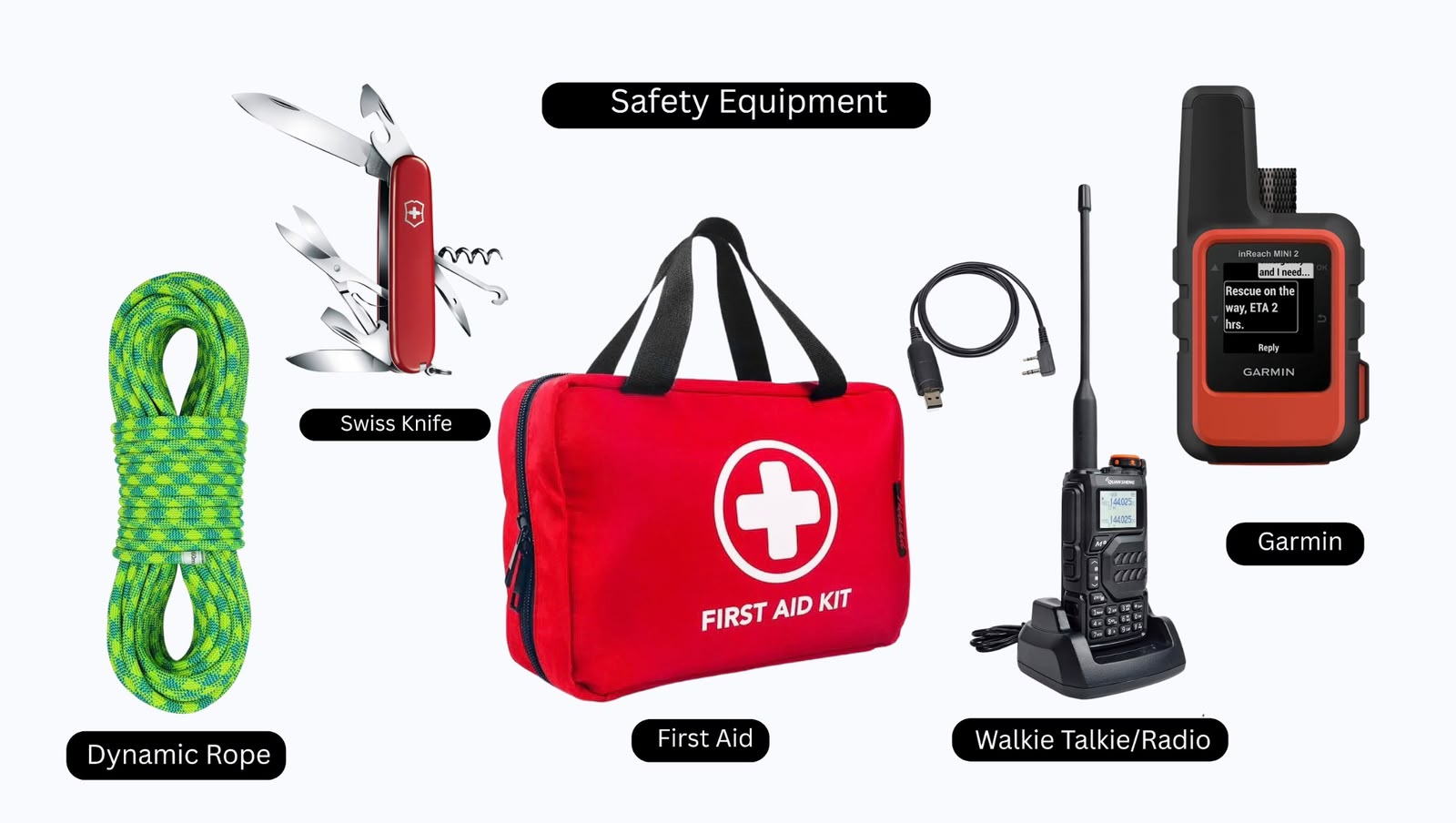
1. Dynamic Rope
This specialized nylon rope is engineered with a specific amount of elasticity or stretch. It acts as a life-safety line by catching a climber during a fall. The dynamic stretch absorbs the massive impact forces generated by a falling body, protecting both the climber from severe trauma and preventing rock anchors or ice screws from pulling out of the wall.
Popular Brands: Petzl, Beal, Mammut, Sterling
Recommended Quantity: As per expedition requirements
Buy or Hire: Provided by expedition operators
2. Swiss Knife (Multi-Tool)
This compact, pocket-sized multi-tool integrates a variety of folding blades and mechanical instruments. It provides versatile utility for gear repairs, first-aid adjustments, and daily camp survival tasks. Whether cutting the technical cord, trimming medical tape, tightening a loose screw on a crampon, or opening a ration package, it bundles dozens of essential functions into a lightweight chassis.
Popular Brands: Victorinox, Leatherman
Recommended Quantity: 1
Buy or Hire: Buy in Kathmandu
3. First Aid Kit
This dedicated, highly visible zippered bag is packed with essential medical supplies and trauma gear. It provides immediate medical treatment for injuries, ranging from simple blisters and deep cuts to severe alpine emergencies like fractures or frostbite. It organizes bandages, sterile gauze, antiseptic wipes, splints, and emergency medications in a protected case.
Popular Brands: Adventure Medical Kits, Lifeline
Recommended Quantity: 1 (shared between climbers)
Buy or Hire: Buy in Kathmandu
4. Walkie Talkie / Radio
This rugged, handheld two-way radio transceiver is equipped with a long-range antenna and charging dock. It maintains real-time local communication between climbing teams, high-altitude camps, and base camp managers.
It operates over specific VHF or UHF radio frequencies to pierce through mountain terrain, vital for coordinating rope ascents, checking weather updates, and calling for immediate assistance during emergencies.
Popular Brands: Baofeng, Motorola Solutions, Icom, Yaesu
Recommended Quantity: 1 per team
Buy or Hire: Provided by expedition operators
5. Garmin (Satellite Communicator)
This compact, rugged satellite tracker and messaging device provides a life-saving global communication link when operating completely outside cellular network coverage. The device connects directly to global satellite constellations, allowing climbers to track their live GPS path, send and receive text messages anywhere on Earth, and trigger a dedicated interactive SOS signal to coordinate professional international search and rescue operations.
Popular Brands: Garmin, ACR Electronics, ZOLEO
Recommended Quantity: 1 per team
Buy or Hire: Provided by expedition operators
J. Daily Use Items
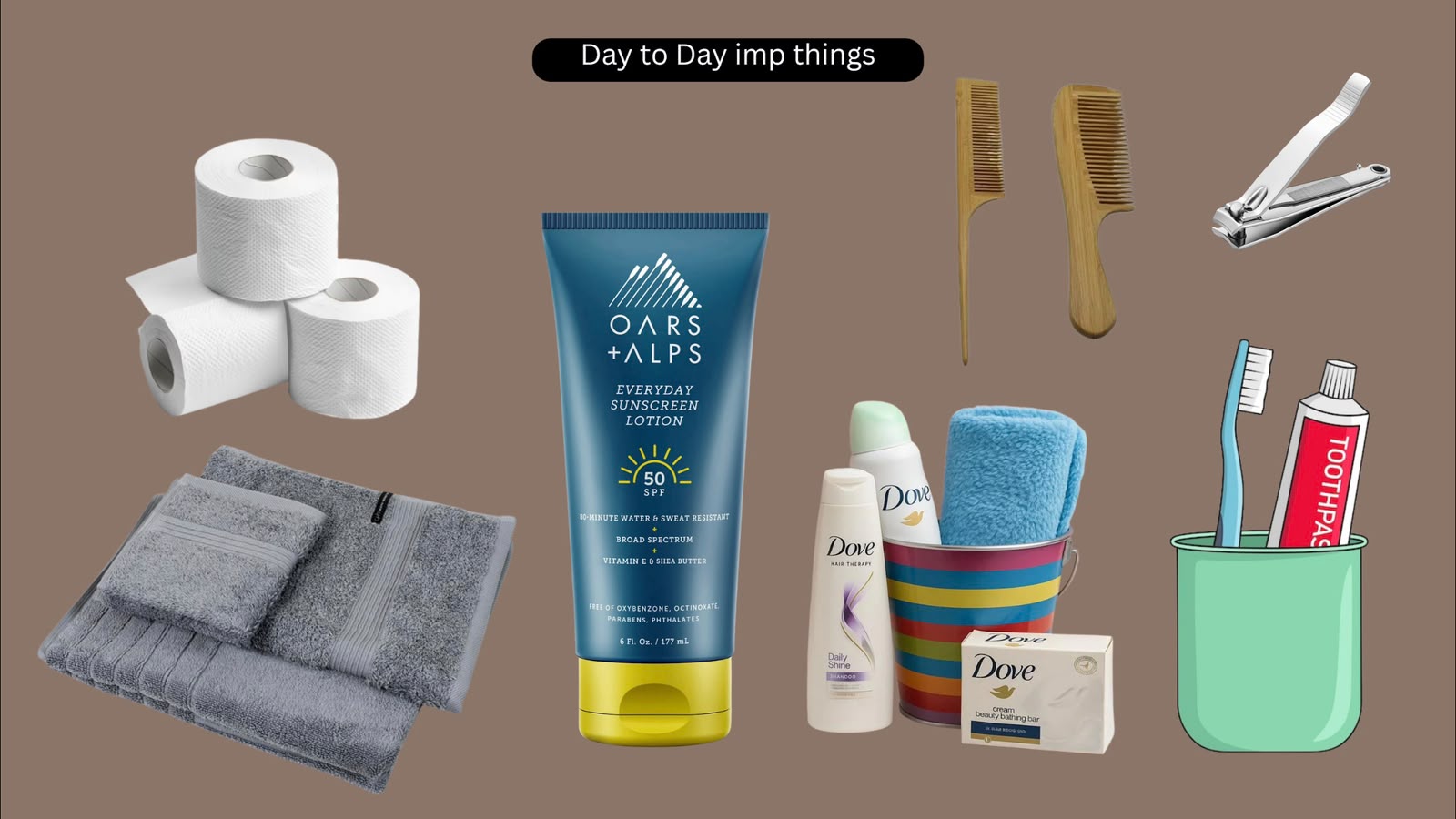
1. Toilet Paper
This basic sanitation necessity is essential for any outdoor journey. It maintains personal hygiene when using campsite toilets or wilderness restroom spots. Keeping it in a waterproof zip bag ensures it stays dry and usable regardless of rain or snow.
Recommended Quantity: As per expedition duration
Buy in Kathmandu
Related Articles: Trekking and Expeditions for Differently Abled Adventurers
2. Quick-Dry Towel
This lightweight, highly absorbent cloth is designed for travel and outdoor use. It is used for drying off after a basic wash or wiping away sweat during a hard day of trekking. Unlike regular cotton towels, these pack down very small and dry quickly in the sun or in a tent to prevent odor and bacterial buildup.
Recommended Quantity: 1
Buy in Kathmandu
3. Sunscreen Lotion
This protective skin cream has a high Sun Protection Factor. It shields exposed skin from intense ultraviolet rays, which become much stronger and more damaging at high altitudes. Applying it regularly prevents painful sunburns and long-term skin damage caused by direct sunlight and snow reflection. SPF 30 or higher is recommended.
Recommended Quantity: 1 to 2 bottles
Buy in Kathmandu
4. Basic Washing Kit (Soap and Shampoo)
This compact collection of toiletries is used for cleansing the body and hair. These items help wash away accumulated dirt, sweat, and oils after days on the trail. Using small or biodegradable versions allows trekkers to stay refreshed and maintain basic cleanliness at tea houses or base camps.
Recommended Quantity: 1 kit
Buy in Kathmandu
5. Comb and Nail Clippers
These simple, lightweight grooming tools are for hair and nail maintenance. The comb keeps hair untangled and manageable under beanies or helmets. The nail clippers keep toenails short, preventing them from painfully jamming into the front of boots during long downhill descents.
Recommended Quantity: 1 each
Buy in Kathmandu
6. Toothbrush and Toothpaste
These standard daily oral care tools are packed in a travel-friendly format. They keep their teeth clean and their mouths fresh during the expedition. Maintaining oral hygiene prevents dental discomfort or infections during long trips far away from medical facilities.
Recommended Quantity: 1 kit
Buy in Kathmandu
K. Technical Items
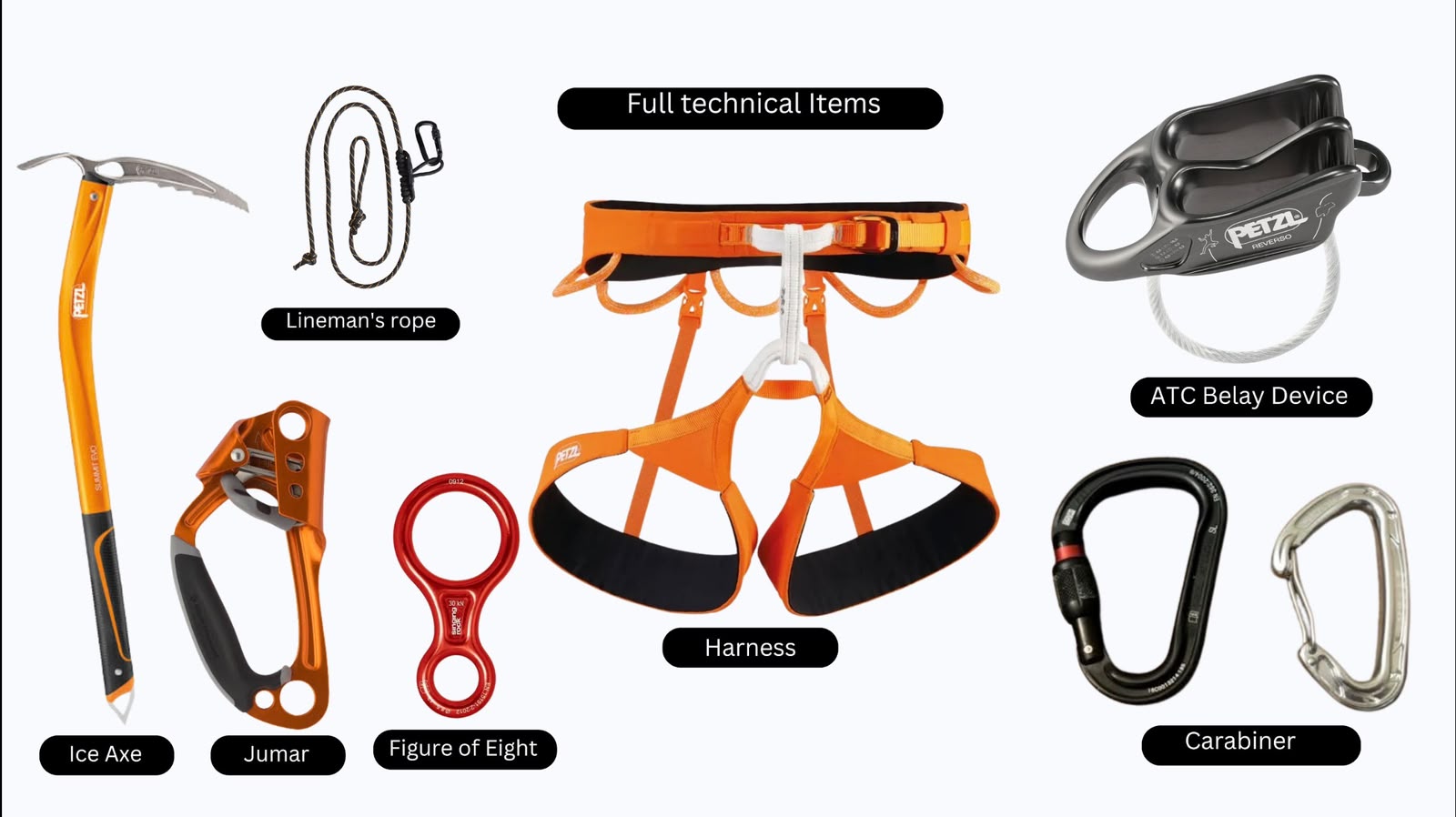
1. Ice Axe
The ice axe is an iconic multi-purpose tool featuring a sharp metal head, a pick, a spike at the bottom, and a shaft. Its most critical job is safety, specifically performing a self-arrest to stop a climber from sliding down a steep snow or ice slope during a fall. It is also used as a walking cane for balance on glaciers, for cutting steps into hard snow, and for secure anchoring in alpine terrain. A 60- to 70-centimeter length works for most people, depending on height.
Popular Brands: Petzl, Black Diamond, Grivel, Camp
Recommended Quantity: 1Pair
Buy or Hire: Hire in Kathmandu
2. Jumar (Ascender)
A Jumar is a mechanical handheld device fitted with a one-way cam mechanism. It allows a climber to safely ascend fixed ropes on steep mountain faces. The internal cam features sharp teeth that bite into the rope, allowing the device to slide smoothly upward when pushed but locking instantly under weight to prevent the climber from sliding backward.
Popular Brands: Petzl, Black Diamond, Climbing Technology
Recommended Quantity: 1
Buy or Hire: Hire in Kathmandu
3. Figure of Eight
This classic, heavy-duty friction brake device is machined from aluminum or steel alloy. It is used for rappelling down steep drops or lowering heavy loads. By weaving the climbing rope through the large and small loops, it creates predictable friction against the metal, allowing a climber to control descent speed smoothly and safely.
Popular Brands: Black Diamond, Camp, Mammut
Recommended Quantity: 1
Buy or Hire: Hire in Kathmandu
4. Lineman’s Rope (Cows Tail / Lanyard)
This heavy-duty safety cord or webbing lanyard is configured with loops and a connecting carabiner. It keeps a climber safely anchored to a fixed anchor point, high-altitude line, or belay station while standing on a precarious ledge. It acts as a short, secure tether that ensures the climber remains connected to the mountain face even when adjusting other gear.
Popular Brands: Petzl, Black Diamond, Mammut
Recommended Quantity: 1
Buy or Hire: Hire in Kathmandu
5. Harness
The harness is a critical piece of wearable safety gear consisting of a reinforced waist belt, leg loops, and a central belay loop. It securely attaches the climber to the life-saving rope system, safely distributing the violent forces of a fall across the hips and thighs to prevent internal injury. It serves as the central hub where the climber ties into the dynamic rope and attaches essential climbing gear like carabiners, ascenders, and belay devices via built-in gear loops.
Popular Brands: Petzl, Black Diamond, Arc’teryx, Mammut
Recommended Quantity: 1
Buy or Hire: Hire in Kathmandu
6. ATC Belay Device
This compact, dual-slot metal friction device is an auto-blocking tube-style device. Its critical job is to manage the friction of the rope while belaying a partner or rappelling. It provides controlled rope feeding and locking capabilities for safe climbing operations.
Popular Brands: Petzl, Black Diamond, Wild Country
Recommended Quantity: 1
Buy or Hire: Hire in Kathmandu
7. Carabiner
Carabiners are high-strength metal loops equipped with spring-loaded opening gates, including locking screw-gate and non-locking styles. They act as the primary connectors that link the entire safety chain together, joining the climber’s harness to ropes, anchors, protection devices, and hauling gear.
Locking variations feature a threaded sleeve that screws over the gate, preventing accidental opening during critical safety maneuvers.
Popular Brands: Black Diamond, Petzl, DMM, Camp
Recommended Quantity: 3 to 5 (various types)
Buy or Hire: Hire in Kathmandu
Essential Preparation Tips for High-Altitude Gear
- Break in your boots: Walk at least 50 to 100 kilometers in new trekking boots before departure. New boots on the trail cause serious blisters that can end an expedition.
- Test all gear: Use all equipment before the expedition to identify any issues. Check zippers, buckles, and seams on everything.
- Pack light: Porters and yaks have weight limits; bring only essentials. Every kilogram matters at altitude.
- Layer properly: The layering system is more effective than a single heavy garment. Adjust layers according to weather and activity level.
- Hire technical gear in Kathmandu: High-quality equipment is available for rent at reasonable rates. There is no need to purchase expensive technical equipment that may only be used once.
- Confirm with your operator: Verify which items are provided before purchasing or hiring. Most expedition operators provide down suits, sleeping bags, and group technical equipment.
- Carry a headlamp with spare batteries: Essential for early morning starts and navigating around camp.
- Bring a power bank: Charging outlets are limited above 4,000 meters. A 20,000 mAh power bank is recommended.
Why Proper Gear is Important for Expedition Success
Proper gear selection is the foundation of a successful Himalayan expedition. The right equipment ensures safety, comfort, and the ability to perform at extreme altitudes. While the list may seem extensive, many items can be hired in Kathmandu, reducing the financial burden of purchasing everything new. Focus on investing in personal items that must fit well and perform reliably: base layers, boots, and personal protection gear.
At Kalapatthar Trek & Expedition, we provide high-quality down suits, sleeping bags, and technical climbing equipment as part of our expedition packages. Our experienced guides can also advise on appropriate gear choices for your specific peak and season.
Costs vary widely depending on how much you buy versus hire. Personal items like base layers, trekking boots, and gloves typically cost USD 300 to 800 if bought new. Technical gear such as crampons, harnesses, and ice axes is usually hired in Kathmandu at a fraction of the purchase cost. High-value items like down suits, sleeping bags rated to -40°C, and 7,000m+ climbing boots are generally provided by your expedition operator and don’t need to be bought or hired separately.
Yes. Kathmandu and Thamel have a well-established gear rental market covering technical equipment such as crampons, ice axes, harnesses, climbing helmets, and even climbing boots rated for 6,000m peaks. Rental quality varies by shop, so it’s worth checking gear condition before departure and confirming with your expedition operator which items they already provide as part of your package.
6,000m-rated boots are semi-rigid double boots with a removable insulated liner, built for technical ice climbing on peaks like Island Peak or Lobuche East. 7,000m and 8,000m boots add a third layer, a rigid mid-shell and an integrated knee-high gaiter, designed specifically for Death Zone conditions where temperatures fall below -40°C. The two are not interchangeable; using 6,000m boots on an 8,000m peak risks severe frostbite.
No. A down suit is only necessary above 7,000m, on expeditions like Manaslu, Ama Dablam, or Everest summit attempts. Standard teahouse treks such as Everest Base Camp, Annapurna Base Camp, or the Annapurna Circuit don’t reach altitudes or conditions that require one; a good down jacket and proper layering system is sufficient.
Peak climbing above trekking altitude typically requires a harness, crampons, an ice axe, a climbing helmet, a jumar for ascending fixed ropes, a figure-eight or ATC belay device for rappelling, and locking carabiners. Most of this technical gear is available to hire in Kathmandu and is not needed for standard teahouse trekking routes.
2 to 3 upper body base layers and 2 lower body base layers is generally sufficient, since they can be washed or aired out between wears at lower-altitude teahouses. Above base camp, where washing isn’t possible, moisture-wicking fabric becomes essential to avoid staying damp in freezing conditions.
A basic personal kit should include blister treatment, adhesive bandages, antiseptic wipes, altitude sickness medication (as advised by a doctor), a pulse oximeter to monitor blood oxygen levels, and any personal prescriptions. Your guide or expedition operator typically carries a more comprehensive shared first aid kit for the group.
For standard teahouse treks on popular routes like Everest Base Camp or Annapurna Circuit, mobile networks and Wi-Fi generally cover most stops, though connectivity drops at higher elevations. For remote or restricted-area treks, or technical peak climbing away from cellular coverage, a satellite communicator is strongly recommended for GPS tracking and emergency SOS capability. Expedition operators usually provide one for group use on higher-altitude climbs.
Porters and yaks typically carry loads with defined weight limits per trekker, so packing light matters. Focus on packing only the layering essentials, personal technical gear, and daily-use items, and rely on your operator for shared camping equipment, food, and group technical gear rather than duplicating what’s already provided.
Either is fine as long as the boots are properly broken in. If buying new, walk at least 50 to 100 kilometers in them before departure. Fit matters more than brand, since ill-fitting boots on multi-day treks are one of the most common causes of blisters serious enough to affect the trip.
0 Comment